Paypal Donation

Help save the bees!

A blog following the beekeepers at the University of Washington.

Saturday, May 4, 2013

Donor prizes

Hey everyone! It's our pleasure to present to you all the potential prizes you can receive for being the top 3 Microryza donors:


We are going into full drive as the warm weather hits us with all its glory! We have recently received new hives, and are in the process of trapping swarms. Here are our new hives, with brand new crew: 


Some of our UW bee interns present, working ever so vigorously with Evan, our beekeeping professor:


Next week Tuesday (May 7th) will be our May meeting, so be sure to stop by! Stop by to see the beeeessssssssss!!!!


Monday, April 22, 2013

Bees and art


So we have finally made the seed bombs on Friday last week, which should be dried already and ready to go this week. We will keep you posted on when we will be pelting the seed bombs around campus.

Another exciting news we have here for you today is Masha's Bee Art!                                               


Masha has a history with art along with working with bees, and she has amazingly combined the two to create innovative designs.


She has agreed to collaborate with the UW Bee Group, and we are happy to announce that donors of our Microryza project may also receive Masha's beautiful art pieces as prizes! To learn more about Masha and her history, please click here.


Thursday, April 18, 2013

SEEED BOMBS

Ok! It's been decided! SEED BOMBS TOMORROW, FRIDAY 04/19/13!

We will be meeting by the UW Greenhouse at 3:30PM, so stop by! We can pretend we're throwing ninja stars (except they're actually seeds).

Tuesday, April 16, 2013

Paws on Science and beyond!

Paws on Science last week at the Pacific Science Center went well! We had a whole team of people show up (thank you all volunteers!!), and had a great time with all the children and parents who stopped by. Lots of questions and curiosity, not just from little kids but also their parents! Hopefully we've convinced a whole bunch of them to become beekeepers, or at least made them more aware of bees and their environment.


The group is also planning on throwing seed bombs (yes, little sacs that can burst with seeds) by the end of this week! It will either be Friday afternoon or Sunday morning if you would like to join, and information will be finalized by this Thursday (04/18/13)!

Also, though we have mentioned this continuously, we appreciate any help we can get! Volunteers and donations are always welcome! Remember, your funds will go towards sustaining our program and enabling our research! For more information on how you can donate, please visit our Microryza Project Website

We will keep you posted on future events! You can also check us out at Facebook~!

Sunday, March 24, 2013

The weather is warming up! That means...

Bees will be picking up activity as Seattle as we transition to April. And with that, our tasks and schedules will be just as hectic!

The first week of April will be our Paws on Science volunteer event at the Pacific Science Center! We'll be there Friday to Sunday (April 5~7), and this will be a great chance for everyone to come to learn about bees. It's also a great occasion to socialize and meet new people!

We also have another Microryza project available for funding for the next few months. Any help would be greatly appreciated! Tell your friends, tell your family, tell your significant other! Publicity helps too~

Are you not curious about what goes into your wax products?
UW Microryza: Discoveries Made Possible Through You!

Stay tuned to our site or Facebook group for more information on upcoming events and activities! Feel free to contact us if you have any questions about our group or plans.


Monday, March 18, 2013

Wax Purification - This Year’s Plans

We have our sights set on concluding the work we began in 2012. Last year we came up with good sources of wax to test, built a solar wax melter, generated samples, ran some sample preparations, and found an analytical laboratory anxious to help. However, we were held up at the analysis stage, mostly by the cost. Our samples will take over $200.00 each to analyze. The tests cover a number of common contaminants and are precise to the parts-per-billion. This is the type of data we’d like to see, but we can not get around the cost.

Microryza to the rescue! This season’s round of crowd-funding will focus on getting the money to have our analyses done. We will also need to purchase some more hive parts, frames & foundation, more bees, and some pest management supplies, all routine beekeeping expenses. We have a detailed budget for anyone to examine.

Plans. We will generate a new series of samples from treatments similar to those used in 2012, being ultra-cautious not to cross-contaminate, and select 8 of them for analysis. Processing will be similar, running each sample through a carbon filtration system. However, we will probably not use the solar wax melter, as our solar days are so limited (it takes all day full sun to operate and that’s just not dependable in Seattle, even in summer.) This year, pending success with Microryza, we should have funds to proceed with analysis by the time we have the samples ready. Results should be available in the Fall.

The big IF. Success of this method (significantly reduced contamination of wax) is not guaranteed. However, if it works we will proceed to send our results to one of the major beekeeping journals for fast publication. Depending on tidiness our procedures and the quality of the results, we may even send to one of the peer-reviewed beekeeping science journals. What happens next is hard to guess. Beekeepers are a practical lot. If they can find a way to incorporate the procedure into their operations economically, we could see this become an important contribution to the new era of beekeeping. Many people and organizations would be to thank!

Stay tuned for updates! Contribute to our effort! Here’s our donor link:


https://www.microryza.com/projects/training-students-to-be-next-generation-beekeepers


Wednesday, March 13, 2013

Microryza Rides Again for Bee Science!

We have a new, improved, updated, Microryza crowd-funding donations page! Here is the link:

https://www.microryza.com/projects/training-students-to-be-next-generation-beekeepers

Last year, Microryza helped us earn enough to support continuation of the bee program, the bee course, and its associated research. By summer, this money will be gone, so now we are starting a new funding cycle.

If you are a potential contributor, go to the site and read more about our cool work. If you are a current UW Farm Bee Group participant, forward this link to all you know! We have super goals, so don't be shy to ask for donations to our cause. Microryza is the way to donate.

Thanks to the funding wizards, our friends at Microryza! You will be sweetly rewarded!

Friday, February 15, 2013

Springy Day!

Most Spring-like day of the year so far, with temperatures above 55 deg. F, the bees were flying in clouds in front of the hives. They looked healthy, with no signs of the dreaded Nosema disease. It was a perfect time to put on syrup feed and even to take a quick look inside and to put on some protein supplement. Activity at this time of year can be influenced by various things, including whether or not the queen is laying or the basic temperament of the bees. Hive No. 2 contains Italian bees. From the outside, they were quiet, with no noticeable flight. Yet on inspection, their box was full of healthy workers! Maybe it was just not warm enough for their “Italian” dispositions. This was an unusual day, a good test of the air, but there will be cold, gloomy times ahead before the smell of the nectar flow arrives. Supplementary food will be welcome, should help fortify the glands of workers so they can rear more brood, keeping the queen busy.
Testing the air.
Hive 5, ready to roll.

Extra protein, more eggs.

Syrup gone, hungry bees, good sign!

Saturday, November 24, 2012

24 November 2012

We are entering the time when the queen normally tapers down her egg laying to zero as the colony digs in for the long winter. By January she will start laying again. The success of the colony during the entire ensuing year depends on whether they get a good start. We will be experimenting with protein supplement this season, feeding it dry outside of the hive. The bees forage almost anytime when it is 1) light, 2) above 55 degrees F, 3) not raining. So we will see if they will be attracted to the artificial pollen (newest formulation available) as if it were from flowers. If so, this should help the queens build up their egg-laying ability and help nurse bees adequately feed the new larvae. If bad weather is prolonged, we'll feed it internally.

In the 1st attached photo, taken October 28th, you can see that they are still bringing in natural pollen! This scene could repeat itself any month of the year in our location, although the time between such opportunities for the bees gets longer and longer and the flowers become harder to find until Spring finally arrives. You can also see a drone at the far end of the landing platform. This is a bit odd because drones are supposed to be absent after the end of summer. They don't live very long, so the queen in this colony was apparently still laying drone eggs up to October. This is not a good thing. Drones take valuable energy to produce and maintain. They are also the preferred breeding choice for Varroa mites. Drones in the fall may prolong the Varroa infestation, which might otherwise naturally taper off as the queen stops laying drones and then stops laying any eggs.

You can see winterized hives in the second photo. So far, we've only had a couple of cold days, but the bees benefit from insulative retention of heat, their main product of the winter. Two of the "hives" (the tallest ones) are actually double-hives. We're trying this as an efficiency measure - reduces equipment in the field and the colonies can share heat. They are stacked two-high with a double screen separator between them and separate entrances. The 1st photo shows bees from the top hive of one double stack entering their hive from the top of the separator screen (white). They can also exit through the top inner cover entrance.

Next Bee Group meeting: Tuesday, December 4th, 4:00 p.m., Biology Greenhouse

If you would like to be part of the Bee Group, come to the meeting and you can be put on the list serve.


Wednesday, October 31, 2012

October 31, 2012

BRIEF REPORT: Fall has settled in the the bees are settled in with it. We ended summer with a flourish of  preparations, including Varroa mite and Nosema treatments. The results of the summer’s testing of the Fumadil-drench technique were interesting. Apparently it works if the spore count is not too high. Some of the Farm hives had pretty high infestation rates in Spring and into Summer, however, so they are currently still on a treatment regime to try to keep the disease at bay at least until the queens start laying strongly again. See graphs below for results.

The hives are insulated and look a little awkward but the bees will save energy. On Sunday, October 28th, the bees were bringing in a significant amount of pollen, probably from exotic &/or ornamental flowers. They were taking advantage of a relatively warm and dry day after a week of cold and rain. This is a good sign as to the health of the bees and heartwarming to watch. Amazingly, there were also a few drones flying! Normally they are all banished from the hive by the end of summer.

BEE GROUP MEETING: Tuesday, Nov. 6th, 16:00, Biology Greenhouse.
Anyone interested in the bees and especially in volunteering &/or taking the summer course should attend. We’ll recap the year and talk about plans for next.

Items needed:
1-1/2 qt plastic peanut/mixed nut jars (Costco type), for feeders
Rigid insulation 1, 1-1/2, or 2 inch, for hive winterizing
Burlap coffee bags, for smokers
Laundry lint, for smoker tinder
Newspaper, for combining, smoker lighting
Leftover paint (exterior latex), for hives

OUR BLOG:

http://beeinterns.blogspot.com/


Results of test of Fumadil (anti-Nosema) drench

Friday, July 20, 2012

HELP SCIENCE HELP THE BEES!

We are a science-based beekeeping course aiming to improve the plight of bees while training a new generation of beekeepers. The course is sponsored by the Biology Department of the University of Washington, Seattle and the UW Farm*. Our current projects are listed below. As you can see, we are investigating a diversity of bee topics.

We have a shoestring budget, which limits what we can do, but you can help us by donating through our funding tool:


OUR CURRENT PROJECTS

1. Biology and Processing of Bees Wax
Learn in detail about how bees secrete wax, its functions in the hive, chemical properties and industrial uses, and problems, especially pesticide contamination. Build a solar wax melter and render our collection of recyclable combs. Process the wax in an experiment to remove pesticide residues. Make candles.

2. Mite Monitoring & Management Testing
Learn in detail the biology of the Varroa mite and its management. You will consistently monitor mite populations in hives under various treatment regimes to assess their relative performance. Data will contribute to the series begun in 2011.

3. Hygienic Behavior Assessment
Use a standard freeze-kill method to create a uniform "unhygienic" patch in the brood of colonies of several different strains. Assess the ability of the bees to detect dead brood and remove it. This is a behavioral trait correlated with the ability to clean the hive of disease spores and possibly other problems. This test was developed by professional researchers for breeding more "hygienic" bee strains.

4. Dance Behavior and Forager Mapping
Record foraging dances within the hive and translate into a detailed map of foraging range centered on the Farm apiary. Then, to verify the data, go to one of the indicated sites, set up feeding stations, mark bees that arrive, and try to recover the marks in one of the home hives.

*The UW Farm is a group of University students, faculty, and associates that run an on-campus, food-growing, urban organic farm. The Farm is now growing food for the campus food services! Check out the Farm link and come visit!

What do bees do when it rains? If it's not raining very hard, they may brave the storm and continue to fly out for food. But to them, a raindrop is a bucket full! So when it rains hard, as it did this morning, the bees stay home but crowd the porch and wait for the sun! These gobs of anxious bees are just raring to go! As soon as the rain lets up, they're OFF! Great work ethic  -- they have already put up a whole box of honey, even in our cool, wet summer!

Wednesday, July 11, 2012

Featured on The Daily: "Braving The Swarm"

We were featured as a part of The Daily's Double Shot.
Take a look at what our classmates, Alex and Russ have to say about the beekeeping internship!

Saturday, July 7, 2012

Building a Solar Wax Melter!

For one of our class research projects, we are learning how bees secrete wax and testing wax to learn about pesticide contamination. For this purpose, we built a solar wax melter on Saturday to test old comb we have acquired from the apiary. We will use it to process wax and test pesticide residues. Photos from our work party after the jump.


Thursday, July 5, 2012

An unlikely encounter with a bumble bee nest

Salvage shopping for materials for the bee course, my attention was drawn to a "bee nest" in a corner of the yard at the Re Store in Ballard. A sign assured me (with Abe Lincoln guaranteeing it) that bees were at work. I saw none. Later, the counter person explained that bumble bees had taken up residence in the bird house above the sign. On closer inspection I could see that, sure enough, bees were very occasionally coming and going from the box. And they were indeed bumble bees, Bombus mixtus to be exact, a common local species. This is unlikely because this species is not well known to nest in such spaces but prefers ground nests close to the surface. They are often found in compost heaps, for example. Our main above-ground species is B. melanopygus, which often make nests in such bird houses, which are a good dimension for them and may contain fluffy materials from previous bird occupancy. But these B. mixtus, a later-active species, seemed to be doing fine in this abandoned avian apartment. Typical of b.b. nests, it smelled putrid and the entrance was smeared with crusty, caked up excretion. Unlike honey bees, bumble bees are not very clean, they don't really need to be - their colony breaks up and abandons the nest by mid-summer. With some observation I saw one large worker emerge and dash around the entrance several times, wiping her abdomen on the surface, before retreating inside. With some finger-scratching, I eventually coaxed another timid bee to appear briefly and feebly buzz its wings before also retreating. Not much of a defense, typical of this relatively docile species. The obstreperous B. melanopygus would have had me running in seconds.

- Evan

Welcome to our cozy mess!

Bumble bee!


Friday, June 29, 2012

Frankenmoth!

Introduction to wax moths
Oh no! Not another Frankenhive!


Well, not exactly. Turns out that. due to improvements in my barn, the increased winter temperatures have, for the first time, made wax moth an issue in my stored equipment. I found a stack of infested honey frames that needed cleaning up.
Typical wax moth damage. 
(arrow shows an actual adult moth, larval tunnels, and frass)
This frame was almost completely eaten out!
So, just enlisting the help of the Farm hives for the task. Infested frames put on top of the bonified honey supers. The bees will kill the moths, their larvae and eggs, and clean and rebuild the comb.

Return of the Queen of Frankenhive

She's baaaaack!
Well, after several days the class popped the lid on the former Frankenhive to have a look at the tamed throng. Surprize! The top box, supposedly with no queen (having been fatally wounded in action) never-the-less had tons of bees all over the pile of old combs, festoons hanging from the lid, and...eggs & young larvae! So, somehow, a queen was once again with the colony. Where did she come from? Could the damaged queen have miraculously recovered? Was there a sneaker queen in the colony that took over? We may never know. Weird. So, the hive had still been a double-queen affair despite the initial attempt to combine.

To try once again to tame the beast, the known queen from the bottom box was removed, all the bees from the top box (including the mystery queen, hopefully) were shaken and brushed off their old combs onto the new foundation below to join the existing small, now queenless colony there, and then all the brood-containing combs were put back in the to box on top of a queen excluder. Three weeks hence, all the brood will have emerged and the old comb can be recycled and replaced with new foundation. This should be the last step in making a single-queen, strong colony. Or so we hope.

Tuesday, June 19, 2012

Getting Stung

Initiation ceremony - it's not about the pain. Roll up yer sleeve, honey, this is for your own good!

The first activity on the first day of the Bee Course is to get stung. This is as much about how to avoid the pain as curing the anxiety about it and to test for allergic reactions. Advice: quickly scrape off the stinger to avoid maximum venom dosage. Don't squeeze it or you'll inject all the venom.
Yes, the poor bee will die, having left a good part of her innards behind. In nature, though, the attacker will likely flee or think twice before proceeding to harass the colony and one dead kamakazi worker out of thousands of 0.75 X identical twins is a worthwhile loss for the protection.


Saturday, June 16, 2012

Frankenhive!

Saga of the quizzical transformation of a thrown-together hive.

Here is Frankenhive! It was the result of adding 3 different colonies together, 2 from "take-outs", i.e. bees removed from walls, etc., and 1 free swarm. It was not clear that any of these had queens when they were acquired from Jerry the Bee Guy. Also, we were short of equipment, so the easiest thing was to just put them all together and see what happens! The different groups of bees were added on top of one another and separated with newspaper to slow down the mingling of bees, which is supposed to prevent fighting. It got to be quite an impressive tower hive.


Two weeks later, it is time to look inside the monster! Always interesting to peep inside a hive. Well, here is what greeted the beekeeper. Starting from the top box, a massive "festoon" of worker bees, making long chains of each other, swinging like trapeze experts. But no new comb, rather unexpected.
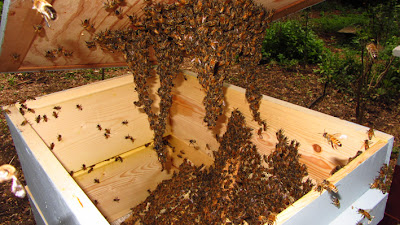
Festoon!
This is a swarm which was being combined with Hive 5 a few days earlier -- the workers, even without a queen, had drawn out several combs from the lid of their box. You can see the edge of it underneath the covering of bees.
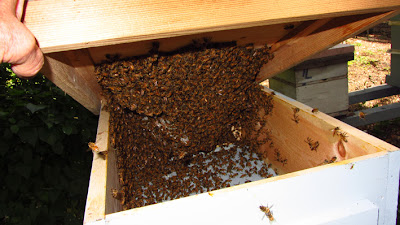
Here is a picture of a similar and more usual situation

Below the festooning mass of worker bees was the original pile of extracted combs covered in bees, many recently emerged. At the bottom of the pile of old comb was one with some new brood, somewhat unexpectedly. And as the last piece was being lifted up, there was a queen! Unfortunately, she had been fatally wounded in the dissection of the hive. So only her workers would survive hence, fine to combine with whatever was in the lower boxes.


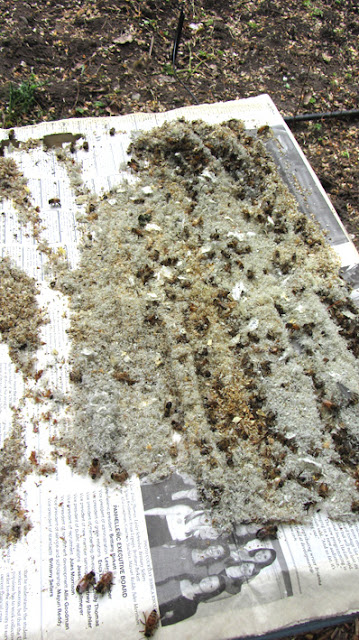
Below the top colony was a box of comb that had originally also received a swarm. But there were no bees in it now and none of the foundation had been drawn. Bees from both the top and bottom boxes had refused it in deference to their old comb. Below this middle box was another layer of newspaper with some corner holes chewed through to the bottom box, as intended, and piles of paper shreds from chewing up of the upper barrier.
Finally, in the bottom box there was another pile of original, natural combs from the first take-out colony. As with the top hive, there was a queen and a small amount of new brood but lots of recently emerged workers. This time the queen was carefully lifted out and temporarily caged to avoid squashing her as the old comb was removed. The worker bees were shaken off and frames placed in the box in place of the old comb. Then the queen was reintroduced to the reconstituted box with her workers. All the brood was moved to the top box, which was then lowered on top of the bottom box with a queen excluder separating the two layers. This will keep the queen from laying eggs in the pile of old comb above while the remainder of the brood emerges from it and will allow eventual recycling of the old comb. The workers will pass down into the queen's box and begin to help rear the brood and, hopefully, under new conditions, draw out the foundation on the new frames. Voila! The monster will transform into a normal hive. It already looks less scary: