Paypal Donation

Help save the bees!

A blog following the beekeepers at the University of Washington.

Showing posts with label honey bees. Show all posts

Friday, July 20, 2012

What do bees do when it rains? If it's not raining very hard, they may brave the storm and continue to fly out for food. But to them, a raindrop is a bucket full! So when it rains hard, as it did this morning, the bees stay home but crowd the porch and wait for the sun! These gobs of anxious bees are just raring to go! As soon as the rain lets up, they're OFF! Great work ethic  -- they have already put up a whole box of honey, even in our cool, wet summer!

Friday, June 29, 2012

Return of the Queen of Frankenhive

She's baaaaack!
Well, after several days the class popped the lid on the former Frankenhive to have a look at the tamed throng. Surprize! The top box, supposedly with no queen (having been fatally wounded in action) never-the-less had tons of bees all over the pile of old combs, festoons hanging from the lid, and...eggs & young larvae! So, somehow, a queen was once again with the colony. Where did she come from? Could the damaged queen have miraculously recovered? Was there a sneaker queen in the colony that took over? We may never know. Weird. So, the hive had still been a double-queen affair despite the initial attempt to combine.

To try once again to tame the beast, the known queen from the bottom box was removed, all the bees from the top box (including the mystery queen, hopefully) were shaken and brushed off their old combs onto the new foundation below to join the existing small, now queenless colony there, and then all the brood-containing combs were put back in the to box on top of a queen excluder. Three weeks hence, all the brood will have emerged and the old comb can be recycled and replaced with new foundation. This should be the last step in making a single-queen, strong colony. Or so we hope.

Saturday, June 16, 2012

Frankenhive!

Saga of the quizzical transformation of a thrown-together hive.

Here is Frankenhive! It was the result of adding 3 different colonies together, 2 from "take-outs", i.e. bees removed from walls, etc., and 1 free swarm. It was not clear that any of these had queens when they were acquired from Jerry the Bee Guy. Also, we were short of equipment, so the easiest thing was to just put them all together and see what happens! The different groups of bees were added on top of one another and separated with newspaper to slow down the mingling of bees, which is supposed to prevent fighting. It got to be quite an impressive tower hive.


Two weeks later, it is time to look inside the monster! Always interesting to peep inside a hive. Well, here is what greeted the beekeeper. Starting from the top box, a massive "festoon" of worker bees, making long chains of each other, swinging like trapeze experts. But no new comb, rather unexpected.
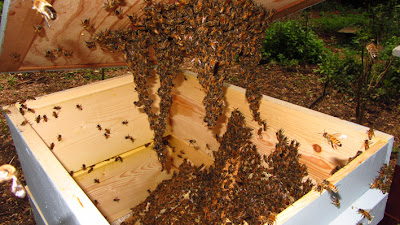
Festoon!
This is a swarm which was being combined with Hive 5 a few days earlier -- the workers, even without a queen, had drawn out several combs from the lid of their box. You can see the edge of it underneath the covering of bees.
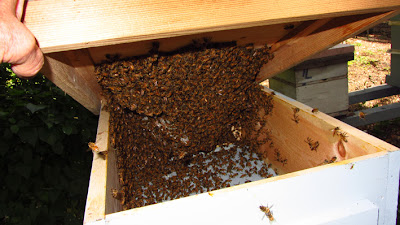
Here is a picture of a similar and more usual situation

Below the festooning mass of worker bees was the original pile of extracted combs covered in bees, many recently emerged. At the bottom of the pile of old comb was one with some new brood, somewhat unexpectedly. And as the last piece was being lifted up, there was a queen! Unfortunately, she had been fatally wounded in the dissection of the hive. So only her workers would survive hence, fine to combine with whatever was in the lower boxes.


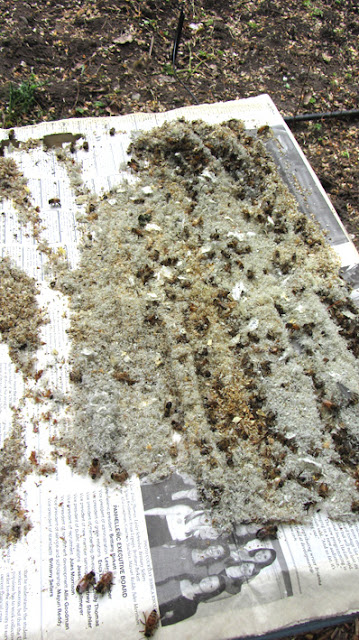
Below the top colony was a box of comb that had originally also received a swarm. But there were no bees in it now and none of the foundation had been drawn. Bees from both the top and bottom boxes had refused it in deference to their old comb. Below this middle box was another layer of newspaper with some corner holes chewed through to the bottom box, as intended, and piles of paper shreds from chewing up of the upper barrier.
Finally, in the bottom box there was another pile of original, natural combs from the first take-out colony. As with the top hive, there was a queen and a small amount of new brood but lots of recently emerged workers. This time the queen was carefully lifted out and temporarily caged to avoid squashing her as the old comb was removed. The worker bees were shaken off and frames placed in the box in place of the old comb. Then the queen was reintroduced to the reconstituted box with her workers. All the brood was moved to the top box, which was then lowered on top of the bottom box with a queen excluder separating the two layers. This will keep the queen from laying eggs in the pile of old comb above while the remainder of the brood emerges from it and will allow eventual recycling of the old comb. The workers will pass down into the queen's box and begin to help rear the brood and, hopefully, under new conditions, draw out the foundation on the new frames. Voila! The monster will transform into a normal hive. It already looks less scary:


Friday, June 15, 2012

New Queens Released, More Swarms


On Sunday our new queens were released into two un-queened receiver colonies and they dove right in. They'd been in cages for 3 days, each getting used to the odors of her new realm. In a month the worker bees will begin to take on her characteristics and we hope for the best!
Jerry the Bee Guy keeps supplying us with bees to fortify the existing hives. The 10th swarm so far (including removal jobs) was added to hive 6 later on Sunday. This is an awkward way to build up the bee population but it should work.

Bee guy

Jerry the Bee Guy saves the day!

Here is Marvin Johnson, a.k.a. Jerry the Bee Guy, bee removal expert and purveyor of fine evicted bee stock, the likes of which now populate several Farm beehives. Colleting docile swarms is easier on the catcher and the bees compared with cutting an entire defensive hive out of a building. But Marvin does this for a living and has helped us save money and build up our hives at a time when bees are no longer available because of high demand and the advancing season

Thursday, June 14, 2012

Royalty On Her Own Time

Queens in transit. A few of her daughter workers are included to take care of her until she is released. 

We waited an extra few weeks. Then an extra 9 nerve-wracking days during which time the "receiver" colonies gave up and began to rear their own queens. Finally they arrived, our experimental stock from "local" breeder in southern Oregon. Immediately they were installed in small "nuc" hives with small populations of anxiously awaiting workers. The nucs were made up from two of the best swarms collected the past 2 weeks. One was queenless after ensconced in a Farm hive but the other had a queen that waited a week to begin laying; she had to be transferred to another swarm hive that was also apparently queenless. The new hybrid queens will be released from their cages in 3 days and should be laying within a day or so in their adopted colony. They are supposed to be "resistant" but these days, this is like saying your cereal is full of "goodness". But they are as local as we could find on short notice and we will be testing them against Varroa mites and for hygienic behavior.


Saturday, June 9, 2012

Boom & Bust Behind Glass

Observation hive dynamics take a downturn.

Queen cells first observed
It became obvious that the observation hive cast off a swarm when 3 queen cells were seen on one of the upper frames. The population of the hive, recently bolstered with the addition of brood and bees from another hive, was also suddenly lower. On June 7th, two of the queen cells were open. By then, the bees had diminished to only enough to cover a couple of frames. A queen was seen among them. However, she seemed lethargic and did not command a very impressive retinue. Sometimes pre-mating queens behave differently, so this could have been the situation. Weather would have prevented mating anytime in the past few days. But on closer inspection, her right rear leg appeared paralyzed, which is possibly why she was slow. She may have been injured in fighting with her emerged sister. This is not a good sign. Will she survive? Will she lay? In a week or so we should know. She may need to be replaced.
Life behind glass is always more precarious than in a normal hive. Fortunately, we have the means to stabilize the situation and should have a vibrant colony on display by Summer term!

Monday, May 28, 2012

Swarms and more swarms!

The intermittent sunny weather is drawing out the season.

A swarm was seen near the apiary over the last weekend. None of us swarm-catchers were there to get it. Still not sure if it came from one of our hives (hopefully NOT) or was incoming. Jerry the Bee Guy also called that he had captured a swarm and could give it to us but again it was on the weekend and the swarmies were predisposed. WE SHALL KEEP TRYING!!!

Wednesday, May 16, 2012

Swarm season! Bees everywhere!

Swarms began to appear a month ago but reached a peak last weekend. Although our 6 swarm traps did not collect any, there was intense scout activity at half of them. A loose swarm was collected in Oregon by Professor Evan Sugden while on a field mission and installed in one of our hives on return. Here are some pics of that exciting adventure (as swarm capture always is!)

Walking into a swarm!


Swarm up close (in a rose bush at McMenamin's, Troutdale, OR).
After it settled for the evening, it was put neatly into a box for transport to UW!


Swarm finds a home!
The swarm box is coupled with a hive, allowing the swarm bees to march right into a perfect new home! (This swarm dispersed 200 miles with some help!) Welcome swarm colony No. 1!


Thursday, May 3, 2012

Cold, Rainy Weather Suppresses Activities

Waiting for those May flowers...

Rainy and cold today. The new hives were mostly not foraging, the older, established hive was sending out workers, however. No pollen coming back, not surprising considering the flower-scouring rain. The bees in the observation hive were cold and clustered toward the bottom, having abandoned a frame of mature brood above. They have no honey, will soon have to feed or take apart to insert a frame of honey. These conditions represent a dangerous crunch time for the bees, who's populations are maxing now even as nectar availability declines. This will definitely slow down the swarm season.

Sunday, April 29, 2012

Observation Hive Installed: A hive morphs from 3 to 2 dimensions!

With great ease, 4 frames from one of the overwintered hives were transferred with the queen to the recently cleaned observation hive and sealed in. By the next day the queen was laying calmly. Weather kept the worker bees in. As sometimes happens, especially with small colonies, it takes a few days for foraging activity to pick up. Here is a pic of the o-hive from mid-summer 2011:


Wednesday, April 25, 2012

New Bees Arrive

Two new packages of bees for the UW Farm hives were collected at Beez Neez Apiary Supply by former student and current Bee Team manager Jamie Bass. They were introduced to the waiting hives, single story with brand new wax foundation. The bees were very slow to "march" into the hives, even though a frame of brood had been placed in each to attract them. The packages were supposed to be queenless; the queens had been ordered from a different source and would be joined with the bees later. However, it was discovered next morning that the packages contained queens none the less (the usual way they are shipped) so the producers had made a mistake. This is why the bees were reluctant to occupy their hives -- they chose to stay with their queen instead, even though this meant spending the night outdoors in a cold screen cage! Next day bees and queens were introduced to the hives and settled in quickly. The plan to allow the bees to rear temporary queens from the provided eggs had to be abandoned. This way, the bees would be able to set up normal operations within hours rather than waiting 2-3 weeks for a new queen to grow up, mate, and begin laying. (The ordered queens will be put in separate, additional hives, or might replace the package queens.) The hives were given sugar syrup to help the workers secrete lots of wax for drawing out the comb, the actual working space of the hive, used for food storage and nursery chambers. All was well 2 days after the operation, with forager bees already bringing home loads of pollen and nectar.


Here is what a package of bees looks like: