She's baaaaack!
Well, after several days the class popped the lid on the former Frankenhive to have a look at the tamed throng. Surprize! The top box, supposedly with no queen (having been fatally wounded in action) never-the-less had tons of bees all over the pile of old combs, festoons hanging from the lid, and...eggs & young larvae! So, somehow, a queen was once again with the colony. Where did she come from? Could the damaged queen have miraculously recovered? Was there a sneaker queen in the colony that took over? We may never know. Weird. So, the hive had still been a double-queen affair despite the initial attempt to combine.
To try once again to tame the beast, the known queen from the bottom box was removed, all the bees from the top box (including the mystery queen, hopefully) were shaken and brushed off their old combs onto the new foundation below to join the existing small, now queenless colony there, and then all the brood-containing combs were put back in the to box on top of a queen excluder. Three weeks hence, all the brood will have emerged and the old comb can be recycled and replaced with new foundation. This should be the last step in making a single-queen, strong colony. Or so we hope.
Paypal Donation
Help save the bees!
A blog following the beekeepers at the University of Washington.
Showing posts with label bee hives. Show all posts
Friday, June 29, 2012
Saturday, June 16, 2012
Frankenhive!
Saga of the quizzical transformation of a thrown-together hive.
Here is Frankenhive! It was the result of adding 3 different colonies together, 2 from "take-outs", i.e. bees removed from walls, etc., and 1 free swarm. It was not clear that any of these had queens when they were acquired from Jerry the Bee Guy. Also, we were short of equipment, so the easiest thing was to just put them all together and see what happens! The different groups of bees were added on top of one another and separated with newspaper to slow down the mingling of bees, which is supposed to prevent fighting. It got to be quite an impressive tower hive.
Two weeks later, it is time to look inside the monster! Always interesting to peep inside a hive. Well, here is what greeted the beekeeper. Starting from the top box, a massive "festoon" of worker bees, making long chains of each other, swinging like trapeze experts. But no new comb, rather unexpected.
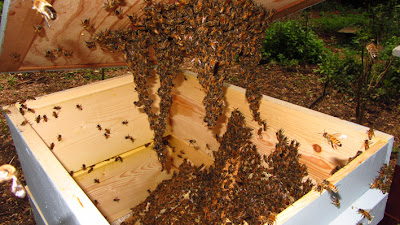
This is a swarm which was being combined with Hive 5 a few days earlier -- the workers, even without a queen, had drawn out several combs from the lid of their box. You can see the edge of it underneath the covering of bees.
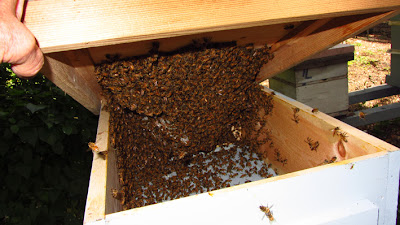
Below the festooning mass of worker bees was the original pile of extracted combs covered in bees, many recently emerged. At the bottom of the pile of old comb was one with some new brood, somewhat unexpectedly. And as the last piece was being lifted up, there was a queen! Unfortunately, she had been fatally wounded in the dissection of the hive. So only her workers would survive hence, fine to combine with whatever was in the lower boxes.
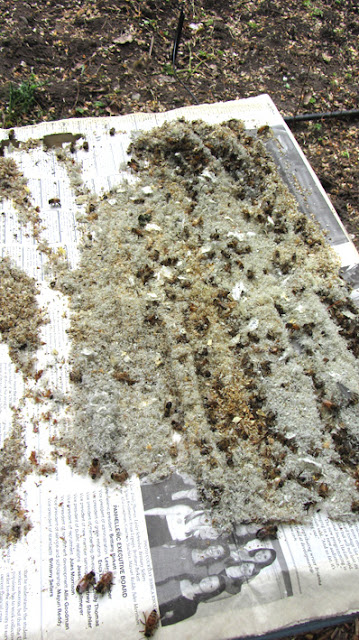
Below the top colony was a box of comb that had originally also received a swarm. But there were no bees in it now and none of the foundation had been drawn. Bees from both the top and bottom boxes had refused it in deference to their old comb. Below this middle box was another layer of newspaper with some corner holes chewed through to the bottom box, as intended, and piles of paper shreds from chewing up of the upper barrier.
Finally, in the bottom box there was another pile of original, natural combs from the first take-out colony. As with the top hive, there was a queen and a small amount of new brood but lots of recently emerged workers. This time the queen was carefully lifted out and temporarily caged to avoid squashing her as the old comb was removed. The worker bees were shaken off and frames placed in the box in place of the old comb. Then the queen was reintroduced to the reconstituted box with her workers. All the brood was moved to the top box, which was then lowered on top of the bottom box with a queen excluder separating the two layers. This will keep the queen from laying eggs in the pile of old comb above while the remainder of the brood emerges from it and will allow eventual recycling of the old comb. The workers will pass down into the queen's box and begin to help rear the brood and, hopefully, under new conditions, draw out the foundation on the new frames. Voila! The monster will transform into a normal hive. It already looks less scary:
Here is Frankenhive! It was the result of adding 3 different colonies together, 2 from "take-outs", i.e. bees removed from walls, etc., and 1 free swarm. It was not clear that any of these had queens when they were acquired from Jerry the Bee Guy. Also, we were short of equipment, so the easiest thing was to just put them all together and see what happens! The different groups of bees were added on top of one another and separated with newspaper to slow down the mingling of bees, which is supposed to prevent fighting. It got to be quite an impressive tower hive.
Two weeks later, it is time to look inside the monster! Always interesting to peep inside a hive. Well, here is what greeted the beekeeper. Starting from the top box, a massive "festoon" of worker bees, making long chains of each other, swinging like trapeze experts. But no new comb, rather unexpected.
![]() |
| Festoon! |
![]() |
| Here is a picture of a similar and more usual situation |
Below the festooning mass of worker bees was the original pile of extracted combs covered in bees, many recently emerged. At the bottom of the pile of old comb was one with some new brood, somewhat unexpectedly. And as the last piece was being lifted up, there was a queen! Unfortunately, she had been fatally wounded in the dissection of the hive. So only her workers would survive hence, fine to combine with whatever was in the lower boxes.
Below the top colony was a box of comb that had originally also received a swarm. But there were no bees in it now and none of the foundation had been drawn. Bees from both the top and bottom boxes had refused it in deference to their old comb. Below this middle box was another layer of newspaper with some corner holes chewed through to the bottom box, as intended, and piles of paper shreds from chewing up of the upper barrier.
Subscribe to:
Posts (Atom)


